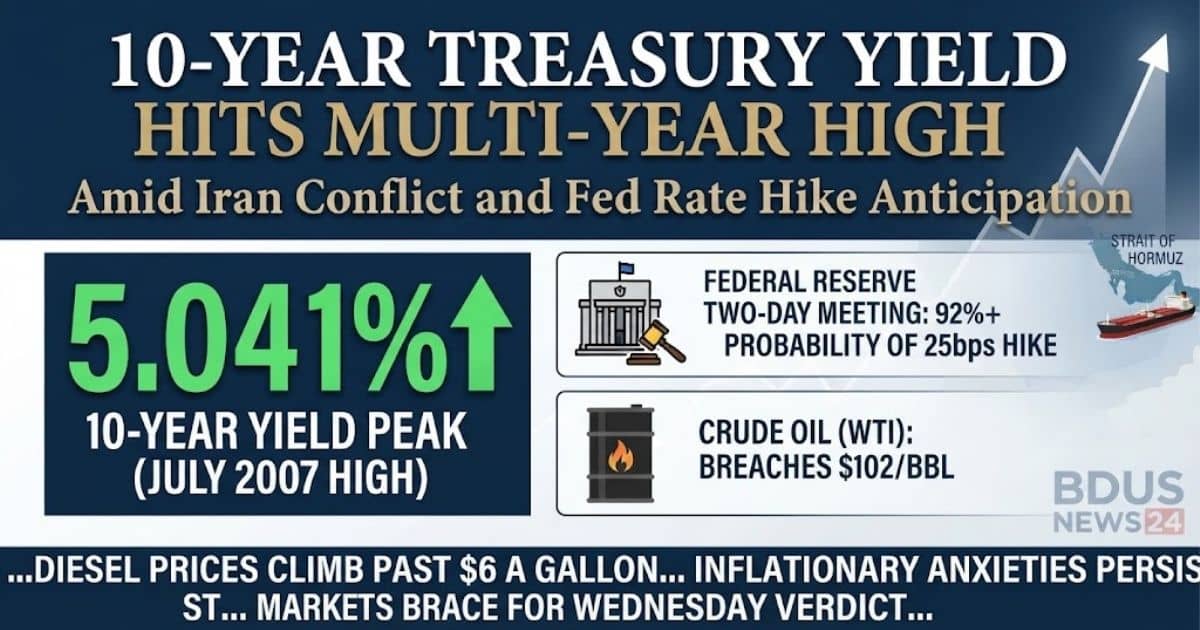
NEW YORK — Financial markets experienced a tense session on Tuesday as benchmark U.S. Treasury yields surged to levels not witnessed in nearly two decades. The 10-year Treasury yield climbed to a peak of 5.041%—marking its highest point since July 2007—driven heavily by soaring crude oil prices stemming from ongoing geopolitical tensions in the Middle East and growing expectations of an impending Federal Reserve interest rate adjustment.
According to market analysts, the dramatic shift in bond yields comes at the onset of a crucial two-day Federal Reserve policy meeting. With recent domestic inflation metrics continuing to hover above the central bank’s targeted 2% threshold, financial traders are pricing in an overwhelming probability of a quarter-point rate hike when the policy decision is officially announced on Wednesday. CME FedWatch data indicates that market participants estimate more than a 92% likelihood for a 25-basis-point increase.
Key Economic Drivers and Market Pressures
The sudden surge in borrowing costs is closely linked to external commodity pressures, particularly the ongoing conflict involving Iran, which has kept the vital Strait of Hormuz effectively constrained. West Texas Intermediate (WTI) crude oil breached the $102 per barrel threshold on Tuesday, continuing a sharp rebound from summer lows when crude traded near $70 a barrel. Consequently, retail diesel prices have climbed past $6 a gallon, compounding inflationary anxieties across major transportation and logistics sectors.
Financial experts point out a remarkably tight correlation between escalating energy costs and shifting Treasury yields. Jonathan Liang, Chief Investment Officer of fixed income and FX at Standard Chartered, noted that U.S. treasuries remain acutely sensitive to persistent inflationary gauges. Similarly, Steve Sosnick, chief strategist at Interactive Brokers, emphasized that geopolitical catalysts have tightened the traditional relationship between crude pricing and sovereign debt yields.
Treasury yield 2027
Despite mounting pressures across financial markets, some officials maintain a more measured perspective. National Economic Council Director Kevin Hassett remarked during a recent media appearance that certain indicators suggest underlying inflationary momentum may be cooling in the near term, though markets continue to brace for the central bank’s upcoming verdict. As the economic landscape unfolds, financial institutions and consumers alike across BDUS News 24 will closely monitor how these fiscal adjustments ripple through corporate borrowing and consumer loan benchmarks. Treasury yield 2027
Read the full analysis on BDUS News 24 economic updates.