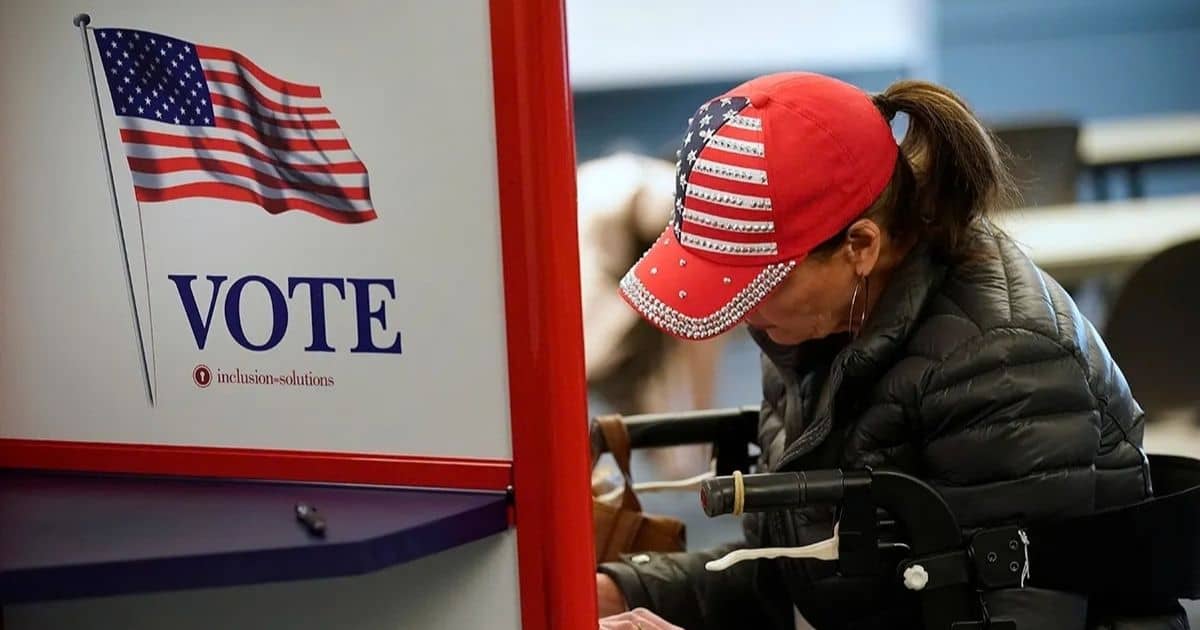
A voter casting a ballot at a polling booth. (Photo: Collection / Fox News / Edited: BDUS News 24)
A federal judge’s recent decision to dismiss charges against a noncitizen voter has ignited a fierce nationwide debate over the boundaries of federal and state authority in U.S. elections.
U.S. District Judge David Leibowitz of the Southern District of Florida dismissed federal criminal charges against Chelsea Cox, a Jamaican-born woman who cast a ballot in the 2020 presidential election despite not holding U.S. citizenship. In his 31-page opinion, Leibowitz ruled that a key provision of the Illegal Immigration Reform and Immigrant Responsibility Act of 1996 (IIRIRA)—which criminalizes noncitizen voting in federal elections—violates the Constitution as applied to Cox.
The ruling strikes directly at federal efforts to restrict voting participation. Leibowitz argued that the Constitution assigns the power of setting voter qualifications exclusively to the states, asserting that the text and the 1787 Constitutional Convention debates support this division of power. He also rejected arguments that the federal government’s broad immigration powers or the Elections Clause grant Congress the authority to establish national voter eligibility criteria.
noncitizen voting
Legal Backlash and Future Appeal Expectations
The decision immediately drew sharp criticism from conservative lawmakers and legal analysts. Senator Mike Lee of Utah, co-author of the Safeguard American Voter Eligibility (SAVE) Act, strongly condemned the ruling on social media, predicting it would be overturned on appeal. Legal experts, including Hans von Spakovsky of Advancing American Freedom and attorney Abhishek Kambil, expressed surprise at the outcome and anticipated that the 11th Circuit Court of Appeals will likely overturn the decision, pointing to historical precedents regarding federal authority over naturalization and election regulation.
While the federal prosecution against Chelsea Cox has been halted, legal experts note that state-level authorities in Florida retain the independent jurisdiction to bring potential state charges. Appointed to the federal bench in 2024, Judge Leibowitz’s latest ruling stands as his most politically sensitive and widely scrutinized decision to date.
Failed Execution of Christa Pike Sparks Fresh Scrutiny Over Capital Punishment