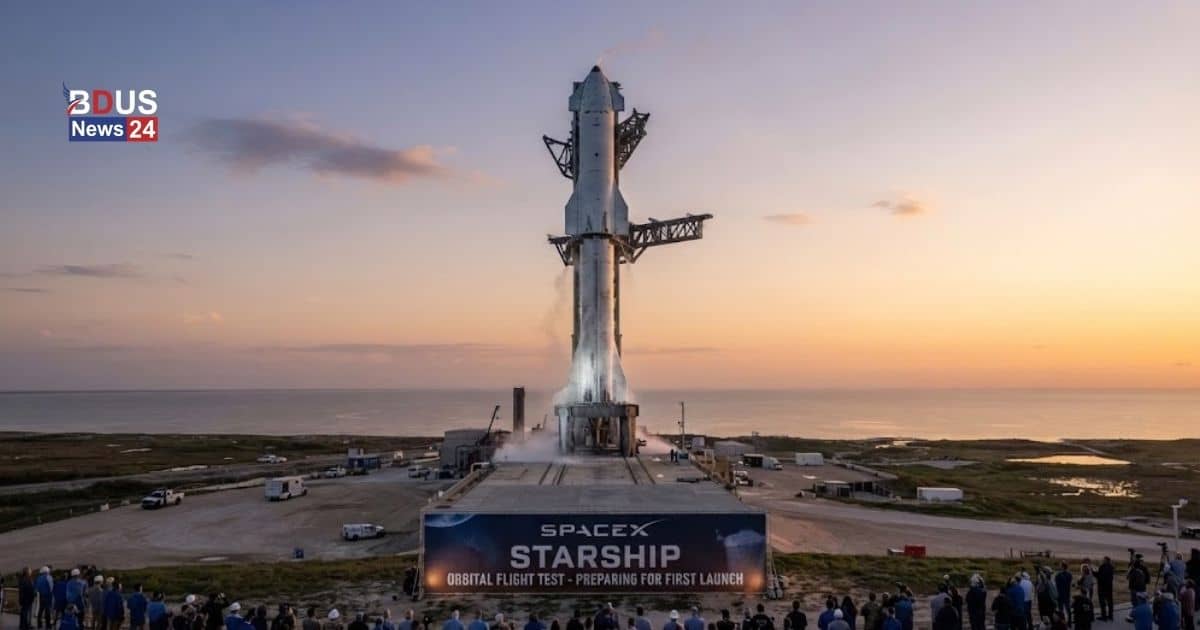
SpaceX Starship rocket preparing for its historic orbital launch test. (Source: SpaceX / Edit: BDUS News 24)
Elon Musk’s aerospace giant, SpaceX, is gearing up for a monumental milestone in space exploration as it prepares for the historic orbital flight test of its massive Starship rocket. This ambitious mission marks a pivotal leap forward for the company, pushing the boundaries of commercial spaceflight and heavy-lift rocketry.
The Federal Aviation Administration (FAA) officially greenlit the crucial operations, granting a license authorization for the upcoming launch and reentry activities. With this official regulatory approval secured, teams at the state-of-the-art facility in Starbase, Texas, are finalizing preparations for the 75-minute launch window.
The Historic Orbital Mission and Starlink Deployment. SpaceX Starship rocket
As the countdown ticks down, anticipation surrounds the primary objectives of this flight. For the first time in the program’s history, SpaceX aims to propel the colossal spacecraft completely into orbit and around the Earth. Furthermore, the mission carries a practical commercial payload: the deployment of 26 brand-new Starlink V3 satellites.
These advanced v3 satellites, manufactured at the company’s Redmond, Washington facility, represent a major technological upgrade. Designed to be larger and significantly more powerful, they feature next-generation solar arrays capable of generating double the power of their predecessors. This enhancement allows them to transmit data to subscribers at much higher speeds. SpaceX Starship rocket
Strategic Importance and Future Interplanetary Goals
Starship serves as the cornerstone of SpaceX’s long-term expansion blueprint, particularly for scaling its highly lucrative connectivity business. Operating a massive constellation of roughly 11,000 active satellites, the company continues to outpace global competitors. Leadership envisions an even greater footprint, noting that the network could eventually deliver internet access to a vast majority of the globe.
Engineered to be fully reusable, the Starship Super Heavy system is built to transport unprecedented amounts of cargo into orbit at a fraction of past costs. While previous iterations served as suborbital stepping stones, this 14th test flight represents the first serious push to circle the globe. Looking ahead, the aerospace firm is readying the vehicle for a high-profile NASA mission next year, intended to return American astronauts safely to the lunar surface. Additionally, executive plans point toward deploying specialized artificial intelligence compute satellites into orbit by 2027.
Autumn Equinox 2026: Understanding the Astronomical Shift and Shorter Days