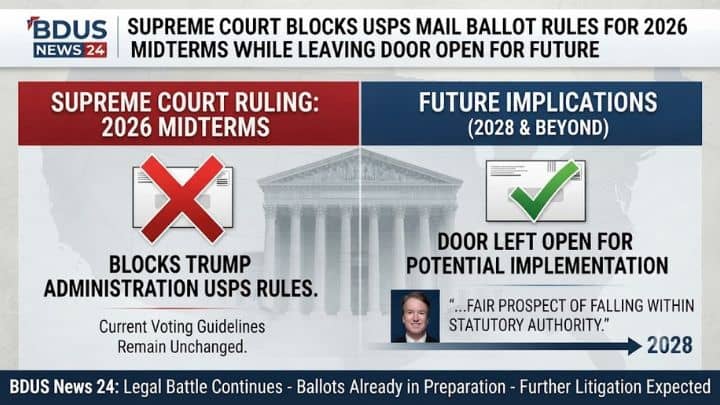
The legal battle surrounding federal voting procedures has taken a major turn as the United States Supreme Court denied the Trump administration’s emergency request to implement new postal service regulations ahead of the upcoming elections. According to recent updates reported by BDUS News 24, the ruling effectively keeps the policy blocked for the 2026 midterm elections, ensuring that current voting guidelines remain unchanged for the immediate voting cycle.
Understanding the Court’s Decision on Trump’s Mail Ballot Rules
The high court’s decision means that a lower court injunction will remain in place, preventing the U.S. Postal Service regulations from taking effect immediately. Legal experts and state officials note that because ballots are already being prepared and sent out to voters, altering the system now would create insurmountable logistical challenges.
However, despite the immediate setback for the administration, separate concurring and dissenting opinions from justices suggest that the core policy could still survive future legal challenges. Justice Brett Kavanaugh indicated in his opinion that the administration’s proposed mail ballot rules hold a fair prospect of falling within the postal service’s statutory authority. This legal opening has given administration supporters hope for potential implementation ahead of the 2028 presidential election.
Legal Perspectives and Future Implications of Election Rules
The disputed postal regulations require federal ballot-mail envelopes to feature specific election-mail logos, high-speed scannability, and specialized individual barcodes for voters, alongside mandatory data sharing with postal portals. A coalition of Democratic state attorneys general originally challenged these requirements, arguing that they violate the Elections Clause of the Constitution.
While critics and opposing states successfully sidelined the mandates for the 2026 cycle due to timing and legal hurdles, analysts point out that a lack of pressing electoral deadlines in subsequent years could make it harder to block the regulations permanently. Legal scholars anticipate further litigation as the case winds its way back through the judicial system. Stay tuned to BDUS News 24 for continuous updates on this developing legal and political story.