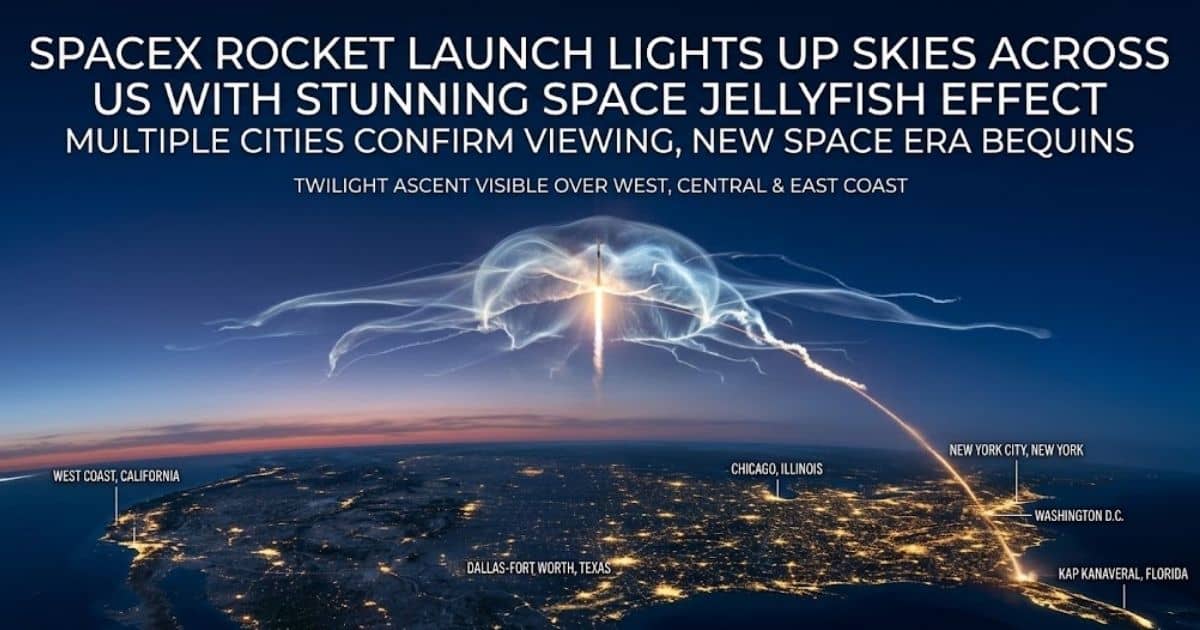
An AI-generated illustrative depiction of the SpaceX rocket launch creating a space jellyfish effect over the US. Image Credit: AI Generated / Canvas Edit | Courtesy: BDUS News 24.
SpaceX has successfully launched its 35th commercial resupply services mission (CRS-35) to the International Space Station (ISS) from Florida’s Cape Canaveral Space Force Station. The early morning liftoff of the Falcon 9 rocket created a breathtaking celestial spectacle known as a “space jellyfish” across multiple East Coast states, captivating onlookers and skywatchers prior to sunrise. The mission carries critical scientific payloads, essential crew supplies, and new hardware to support ongoing microgravity research aboard the orbiting laboratory.
Falcon 9 Blastoff and Cargo Dragon Resupply Mission Details
The Falcon 9 rocket lifted off at 6:33 a.m. Eastern Time from Space Launch Complex 40. Stowed inside the automated Cargo Dragon spacecraft is approximately 6,300 pounds of specialized research equipment, life-support materials, and International Space Station Roll-Out Solar Arrays (iROSA) designed to boost the station’s power capabilities. The first-stage booster completed its planned mission trajectory before executing a precision vertical landing back at Landing Zone 40, marking another successful reusability milestone for the aerospace contractor.
NASA officials confirmed that the Cargo Dragon capsule separated smoothly from the rocket’s second stage shortly after entering low Earth orbit. The spacecraft will execute a series of autonomous orbital burn maneuvers over two days before docking at the space station’s Harmony module. Once docked, astronauts aboard the ISS will begin unloading the extensive cargo to conduct new experiments in cellular biology, material science, and space health.
Science Behind the Glowing Space Jellyfish Atmospheric Phenomenon
The atmospheric phenomenon known as the space jellyfish occurs when a rocket launches during the twilight period just before dawn or right after sunset. As the Falcon 9 climbed through the upper layers of the atmosphere where the sun’s rays still shine, high-altitude sunlight illuminated the expanding plume of exhaust gases from the rocket’s engine. The contrast between the dark ground-level sky and the illuminated glowing gas creates a bulbous, jellyfish-shaped cloud with wispy trails across the horizon.
Residents and photography enthusiasts from Florida to North Carolina captured images of the glowing plume lighting up the morning sky. Scientists explain that the visual effect poses no harm and is a natural physical interaction between rocket water vapor, carbon dioxide exhaust, and high-altitude sunlight. With the CRS-35 cargo mission now underway, SpaceX continues its active schedule of supporting both commercial satellite operations and international space research initiatives.
Historic Award Makes Anti-Apartheid Campaigner the Fifth South African Nobel Peace Laureate