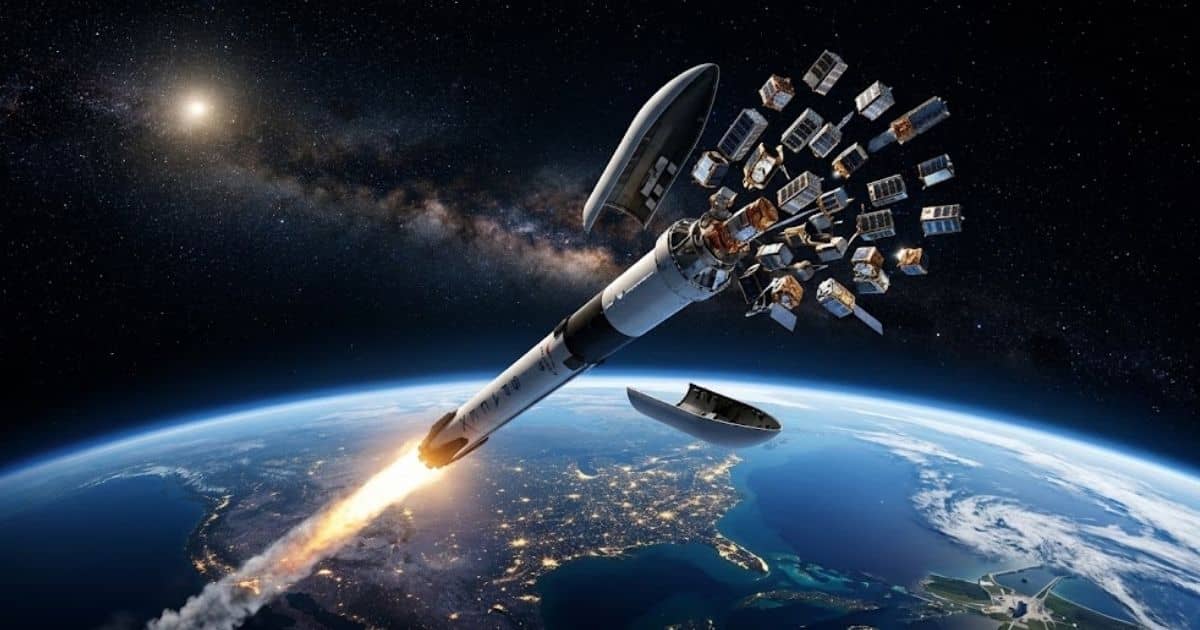
Illustration of SpaceX Falcon 9 rocket deploying satellite payloads into orbit.(Photo Credit: AI Generated | Graphic Edit: BDUS News 24)
Space Exploration Technologies Corp. has marked another major milestone in commercial spaceflight from Florida’s Space Coast. The latest SpaceX Launch saw a flight-proven Falcon 9 rocket lift off from Space Launch Complex 40 (SLC-40) at Cape Canaveral Space Force Station. The mission safely carried dozens of scientific, commercial, and technological satellites into low Earth orbit.
Operating under the direction of founder and CEO Elon Musk, the company executed the Bandwagon-5 rideshare mission following a brief weather delay. The successful liftoff emphasizes the growing global demand for affordable rideshare opportunities into space for private companies, academic institutions, and defense partners.
Overview of the Bandwagon-5 Mission Manifest
The multi-satellite deployment mission carried a diverse manifest of 32 distinct payloads into target orbits. Included in the primary cargo was the Starfall return capsule alongside specialized research hardware, microsatellites, cubesats, and orbital re-entry vehicles. These specialized payloads are designed for pharmaceutical research in microgravity, high-resolution Earth imagery, and next-generation communications testing.
Following the primary propulsion phase, the first-stage booster separated from the upper stage. The second-stage engine then ignited to carry the 32 payloads to their precise deployment altitudes. Flight controllers confirmed the sequential deployment of the satellites over a multi-hour window after liftoff.
Booster Recovery and Reusability Achievements
A defining feature of this SpaceX Launch was the successful return and recovery of the Falcon 9 first-stage booster. Marking its 19th flight to space and back, the reusable booster guided itself back through Earth’s atmosphere using grid fins and cold-gas thrusters.
Approximately nine minutes after launch, the first stage performed a precise landing burnout, touching down safely on the autonomous droneship “A Shortfall of Gravitas,” stationed in the Atlantic Ocean. Droneship recovery operations were supported by recovery vessels prepared to tow the booster back to Port Canaveral for refurbishing and future flight assignments.
Pre-Dawn Visual Effects and Future Operations
Skywatchers across Central Florida gathered near the launch site prior to dawn to catch a glimpse of the rocket’s ascent. Because the launch occurred shortly before sunrise, sunlight illuminated the expanding exhaust plume high in the upper atmosphere, creating a distinct visual phenomenon known as a “space jellyfish”.
With another SpaceX Launch complete, technicians will now focus on inspecting the returned booster while preparing launch pads for upcoming Starlink deployments and commercial satellite missions. The successful execution of the Bandwagon-5 mission reaffirms SpaceX’s position as the primary launch service provider for international orbital missions.
Predicted Line-ups for Premier League Teams in Matchweek 7: Latest Team News and Squad Updates