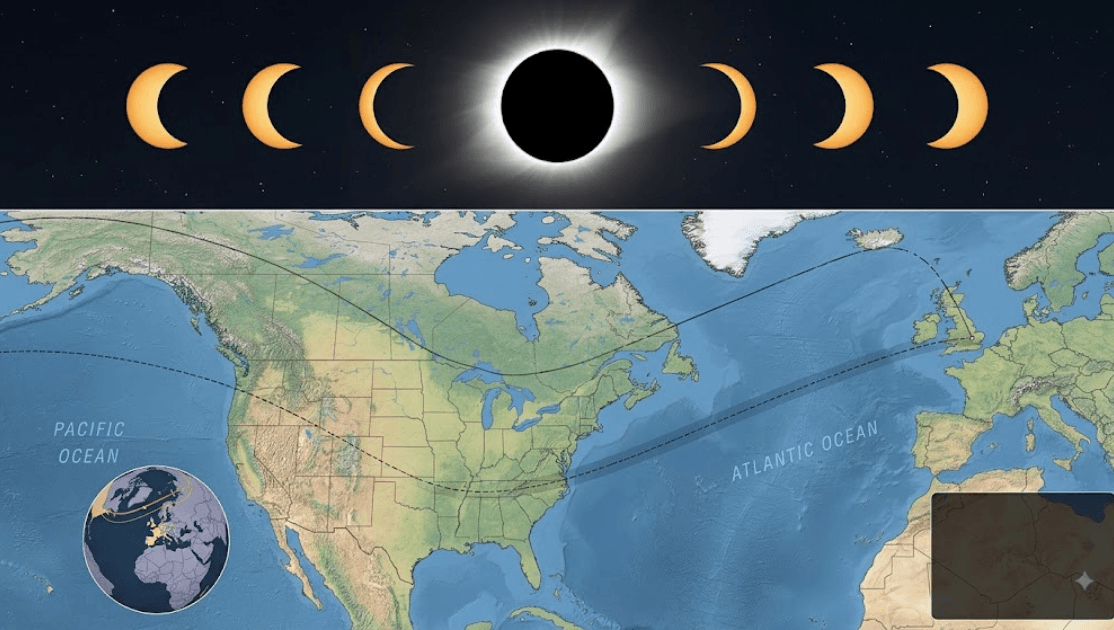
WASHINGTON / LONDON — Skywatchers across the Northern Hemisphere are tuning in for one of the most anticipated celestial events of the decade: the August 12, 2026, Total Solar Eclipse. According to updated data from NASA, the rare astronomical alignment is creating dynamic views across parts of Europe, North America, and Africa.
What Makes the August 12 Eclipse Special?
A total solar eclipse occurs when the Moon passes directly between the Earth and the Sun, completely blocking the sun’s bright face and momentarily turning day into twilight. This event marks the first total solar eclipse visible from mainland Europe in nearly 27 years.
Path of Totality: Where Will the Darkness Fall?
The narrow “path of totality”—where the Sun is 100% obscured—begins near the Arctic region, sweeping through Greenland, Iceland, the Atlantic Ocean, and across northern Spain and a small section of Portugal.
- Iceland & Greenland: Key locations like Reykjavík, Iceland, are witnessing totality during the late afternoon hours.
- Spain: Major Spanish cities including León, Bilbao, and Palma are experiencing totality in the early evening just before sunset, offering a dramatic “sunset eclipse” view.
- Duration: The total eclipse phase reaches a maximum duration of approximately 2 minutes and 18 seconds near the peak path.
Visibility in the United States and Canada
While North America lies outside the direct path of totality, millions of residents are able to observe a partial solar eclipse.
- United States: Northern and Eastern states—including Alaska, Minnesota, New York, and North Carolina—are seeing a partial coverage where the Moon takes a bite out of the Sun. New York City experiences around 10% maximum coverage during the afternoon hours.
- Canada: Most provinces, particularly eastern and northern territories, enjoy an afternoon partial eclipse with varying degrees of coverage based on latitude.
European Visibility Schedule
For the rest of Western, Central, and Northern Europe outside the path of totality (such as the UK, France, and Germany), a deep partial eclipse is visible during the late afternoon and early evening hours.
| Location / City | Eclipse Type | Peak Time (Local Time) |
| Reykjavík, Iceland | Total | 5:48 PM |
| León, Spain | Total | 8:28 PM |
| London, UK | Partial | 7:13 PM |
| Paris, France | Partial | 8:17 PM |
| New York City, US | Partial | 1:54 PM |
How to Watch Safely
Space agencies, including NASA and ESA, emphasize that looking directly at the Sun without proper safety equipment is extremely dangerous. Viewers outside the totality zone must use certified solar viewing glasses (ISO 12312-2 standard) or indirect viewing methods.
For those located outside the viewing areas, NASA is streaming live telescope views and expert commentary online starting at 1:15 PM EDT.
🔗 Read more: US Tightens H-1B and Immigration Rules: Why Indian Professionals Could Be Hardest Hit