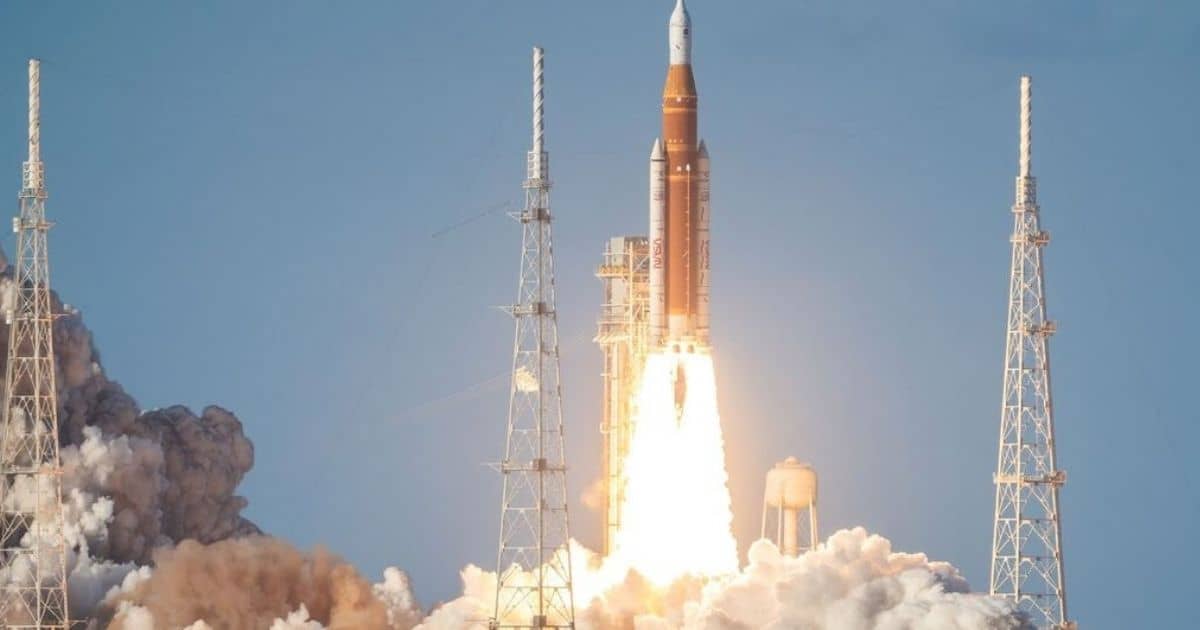
A rocket launching during World Space Week. Image Source: UN News | Courtesy: BDUS News 24.
World Space Week is being celebrated across the globe from October 4 to October 10, marking humanity’s ongoing journey into the cosmos. Following the launch of Sputnik by the Soviet Union in 1957, the United Nations Office for Outer Space Affairs (UNOOSA) was established to monitor space developments. Over the decades, UNOOSA has successfully tracked more than 77 lunar missions and various other space explorations.
The Rocket Revolution: Shaping the Future of Space Travel
The core focus of this year’s global event centers around the theme “Rocket revolution,” which highlights how access to space is rapidly transforming. The modern space sector is expanding exponentially through commercial launch providers, reusable rockets, university student teams, and various technological innovators. With over 50,000 events planned across more than 100 countries, this initiative stands proudly as the largest space event on Earth.
The United Nations has a long-standing history of governing space exploration peacefully. Back in 1959, the UN General Assembly created a dedicated committee to ensure that the exploration and use of outer space benefit all of humanity, keeping safety, security, and global development at the forefront.
Diverse Applications of Space Technology Across UN Agencies
Today, space science and advanced technology play a vital role in supporting at least 25 different UN entities. Their collaborative efforts address critical earthly and orbital challenges through various scientific projects:
- Cosmic Crops: The International Atomic Energy Agency (IAEA) and the Food and Agriculture Organization (FAO) sent specialized seeds to the International Space Station in November 2022 to examine how harsh space environments alter plant genetics to build climate resilience back on Earth.
- Satellite Tele-medicine: The World Health Organization (WHO) teamed up with UNOOSA to leverage satellite technology in solving pressing global health challenges.
- Space Sustainability: The UN Environment Programme (UNEP) actively promotes long-term sustainability in Earth’s orbit, addressing the growing concern of nearly 130 million pieces of space debris, ranging from abandoned spacecraft to tiny satellite fragments.
Reflections from the Final Frontier World Space Week
The experience of witnessing outer space leaves an indelible mark on astronauts. Space travelers often describe the sensation as entering a surreal dream state. Looking back at our home planet from afar evokes a profound sense of unity and deep appreciation for humanity, reminding spacefarers of the beauty and fragility of Earth. As global celebrations continue through October 10, World Space Week serves as a powerful reminder of how far technology has advanced and how much more remains to be discovered beyond the Moon.
Aryna Sabalenka Admits What She Did at the US Open This Year Which Even Surprised Herself