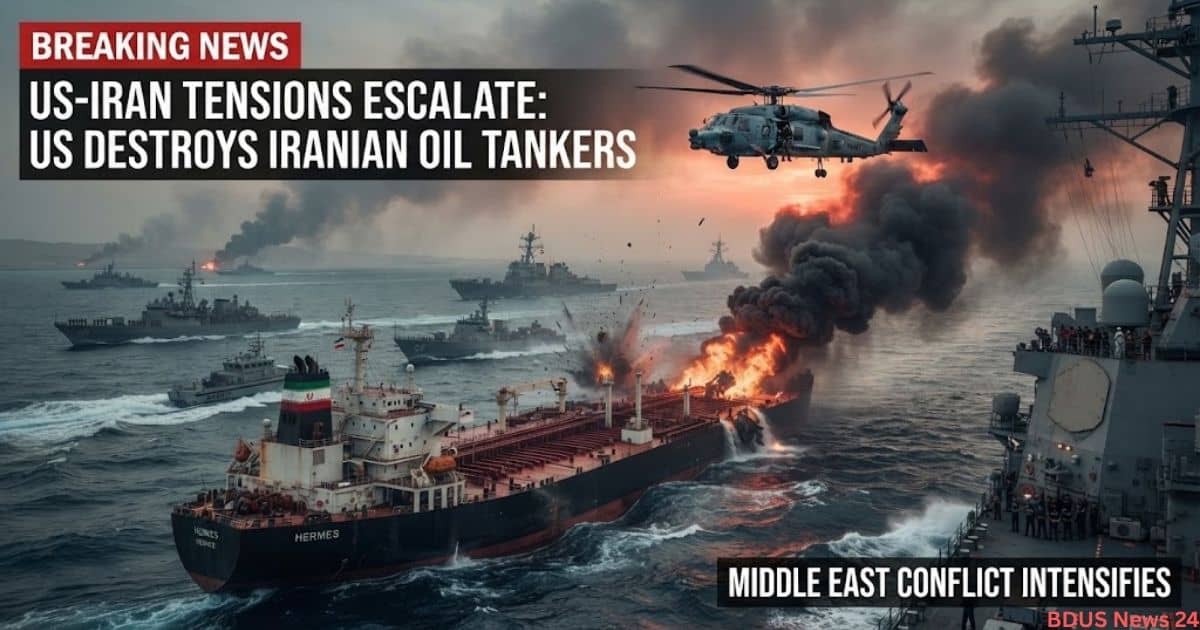
The geopolitical landscape of West Asia has witnessed a dangerous and sharp escalation as direct military confrontations between the United States and Iran intensify. According to recent updates from the region, tensions boiled over after the U.S. military destroyed five Iranian crude oil tankers in the Gulf of Oman, triggering immediate retaliatory strikes from Tehran across multiple fronts. Readers of BDUS News 24 can find a comprehensive breakdown of this breaking international crisis below. US Iran Tensions Oil Tankers Destroyed
U.S. Strikes on Iranian Tankers and CENTCOM Statement
The latest round of intense hostilities began when U.S. Central Command (CENTCOM) forces launched retaliatory strikes against five Iranian oil tankers identified as part of a shadow network funding the Islamic Revolutionary Guard Corps (IRGC) and its regional proxies. The military action came in response to consecutive failed attempts by the IRGC to target a U.S. Navy warship with ballistic missiles over a 48-hour period.
U.S. Secretary of State Marco Rubio firmly addressed the escalation, stating that for every Iranian attempt to strike U.S. naval assets, Tehran will lose its oil vessels. The U.S. military emphasized that crews were instructed to abandon the ships prior to the strikes to prevent casualties. However, these aggressive maneuvers have severely disrupted regional shipping routes and caused global Brent crude oil prices to surge closer to the $100-a-barrel threshold.
Tehran’s Swift Retaliation: Attacks in Jordan and Strait of Hormuz. US Iran Tensions Oil Tankers Destroyed
Failing to let the U.S. actions go unanswered, Iran’s Revolutionary Guard Corps (IRGC) launched severe counter-operations. Tehran claimed responsibility for firing heavy ballistic missiles at the Al-Azraq military base used by U.S. forces in Jordan. While regional reports indicated that local air defenses intercepted the incoming missiles with no reported casualties among American troops, the strike marked a widening of the regional battlefield.
Simultaneously, the IRGC Navy targeted 10 ships—including two U.S. vessels and eight oil tankers—attempting to navigate through a designated “prohibited and unsafe” zone in the critical Strait of Hormuz. Furthermore, warnings were issued to shipping vessels docked in Kuwaiti and Bahraini ports that host U.S. military personnel, escalating fears of a prolonged and uncontained conflict. As global powers scramble to keep energy corridors open, the unfolding situation continues to threaten international economic stability and maritime security. US Iran Tensions Oil Tankers Destroyed